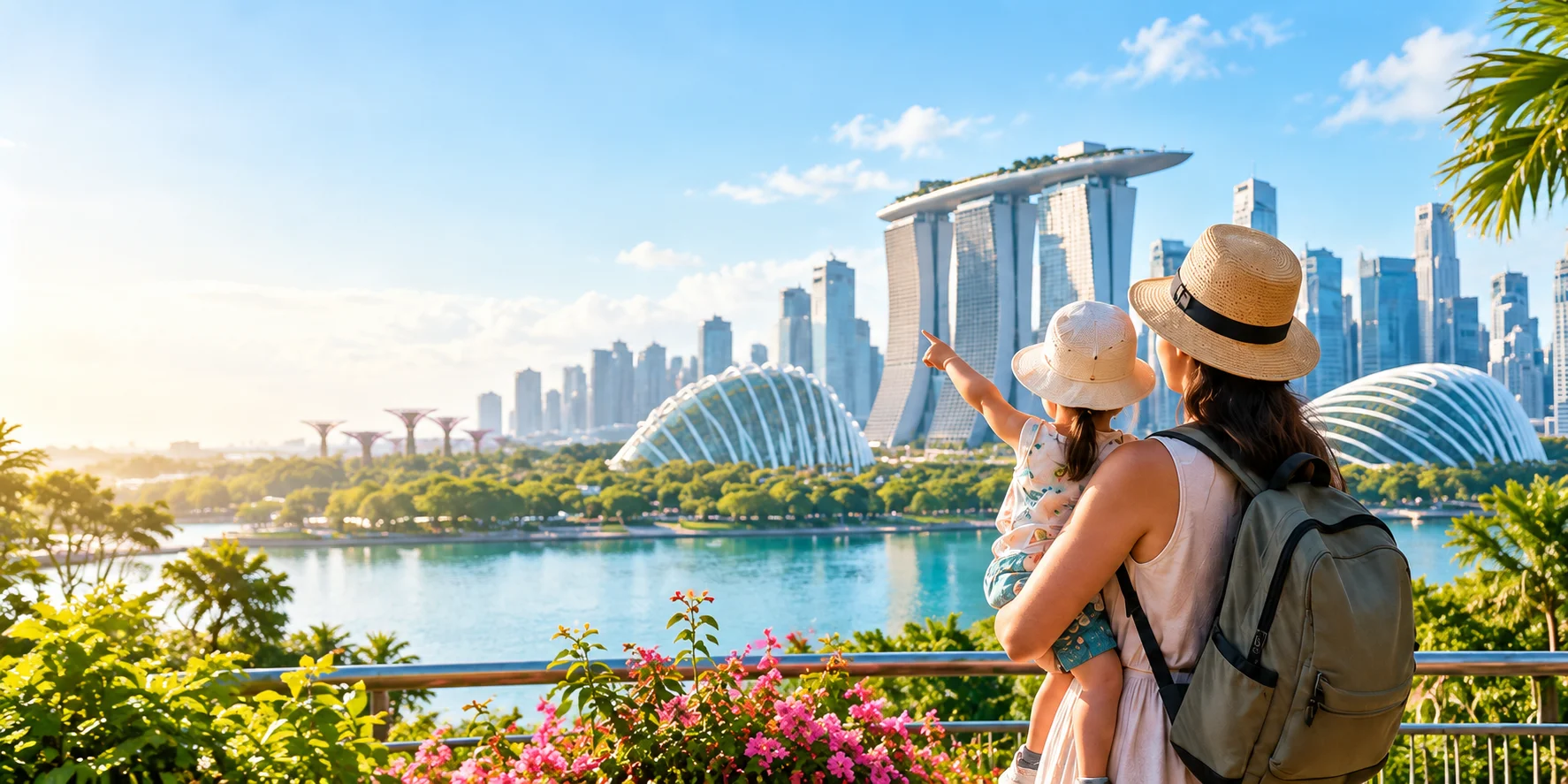
Singapore is a wonderfully welcoming place to visit with children. From shady playgrounds and creative classes to an afternoon at a museum, there is plenty to enjoy at different ages. Here’s what we’d share with friends coming to visit: the practical bits that make a family day out a little easier, with extra tips if you have a baby or toddler.
Sun protection, water and a little cash are useful whatever your children’s ages. If you have a baby or toddler, a few extras can make the day easier — these are the things we bring along.
Sun & shade: hats, lightweight clothing and suitable sunscreen. A little shade makes a big difference here.
Our stroller extras: our UV-protective shade cloth for the stroller, a rain cover for sudden showers and a clip-on fan for hot, still afternoons.
Water play: we pack UV-protective swimwear, a towel and dry clothes for the journey home.
A little layer for indoors: most indoor places are comfortable, but every now and then the air-con catches us out — so a thin extra layer and socks come along.
Drinks: a refillable water bottle for us, alongside our baby’s usual feeding supplies.
Getting around: walking is a good way to explore, though it can get hot even on sheltered walkways. Buses, MRT trains and taxis are other ways to get around. Our notes on child seats and ride options are below.
A little shade helps, but make sure air can still flow freely around your baby. Keep the stroller opening uncovered — heat can build up quickly under a cloth or cover, and babies can overheat. We also keep the fan out of little fingers’ reach.
Cards, contactless and a little cash: most days, a card or contactless payment will get you a long way. We still keep a few Singapore-dollar notes handy for food stalls, small purchases or the occasional cash-only stop. Payment tips
Getting around
Buses, trains and the occasional taxi
Buses and trains with a stroller
Singapore has an excellent public transport network of buses and MRT trains, and you can take a stroller on both. For an easy first trip with little ones, we would start with the MRT.
Once at the station, the lift is your friend. Every MRT station has a barrier-free route, and strollers up to 120 cm long and 70 cm wide can travel open on public transport. A crowded bus or an occupied wheelchair space can mean folding the stroller; waiting for the next bus may be more comfortable.
“Near MRT” does not always mean a quick, sheltered or step-free walk to the venue. Mobile data also helps when checking the route or booking a ride.
Tap and go: you can pay for MRT and public bus journeys with a supported contactless bank card, or a supported card in Apple Pay or Google Pay. Tap in and out with the same card or the same device and wallet — switching between your phone and physical card can cause extra charges. Foreign-issued Visa and Mastercard cards carry an additional S$0.60 fee per day of use.
A little good news on fares: children below 90 cm travel free on basic buses, MRT and LRT when accompanied by a fare-paying adult. At 90 cm or taller, children under seven who are not yet in primary school need a valid Child Concession Card for free travel. Visitors can apply for the card free at a SimplyGo Ticket Office, with the child’s original passport and the accompanying representative’s passport.
Child fares, card expiry & stroller guidance
Express, Premium and City Direct bus services are excluded from free Child Concession Card travel. The card normally expires on 30 April of the year the child turns seven, which can be before their birthday; SimplyGo explains eligibility and any next steps.
Zig, Grab, Gojek and Tada are apps for booking rides; the child-seat option matters more than the car’s size.
Baby in a carrier: we have used Zig → Child, which books a taxi, with our baby in a carrier. That is our experience; a suitable car seat offers better protection.
Child aged one or older: in Grab’s Kids-friendly category, look for Standard | Kids (Age 1–7). Check that the supplied seat suits your child’s age and size.
Older child who can use a booster: look at Gojek GoCar Kids, Tada Junior or Zig’s booster-seat option. Check the current age and size limits in the app before booking.
For a baby or toddler, a correctly installed rear-facing car seat that fits is the safest starting point. A wearable carrier does not replace one, even where taxi rules allow the ride. Bringing your own seat is an option if you want one you know fits.
Prefer a regular taxi? Your hotel can help arrange one, or you can use a taxi stand or call a taxi company. Mention your child’s age and whether you are bringing a car seat.
Booking an ordinary car? Some app bookings send a taxi; others send a driver in a private car. In those private cars, children below 1.35 m need a suitable child seat or booster. With Grab, Gojek or Tada, arrange a suitable seat rather than relying on being accepted with a carrier.
Stroller and luggage coming too? A larger vehicle or suitable Premium option may make the trip easier. It is worth checking that the folded stroller will fit.
Ride options and availability can change, so we would check the app before setting off. A larger car or Premium booking alone does not include a child seat.
When the sky starts looking grey, we look for somewhere indoors. Singapore rain can go from a few drops to a proper downpour surprisingly quickly. The stroller rain cover is handy if we get caught between stops.
Thunder or lightning is the point to leave the pool or water-play area and head into a fully enclosed building. That is one moment to be firm about the plan: a rain cover or an open shelter cannot protect you from lightning.
The sunshine can feel intense, even on a short walk. Our rule of thumb is to save longer outdoor stretches for earlier or later, and make room for shade and indoor breaks — especially from 10 AM–5 PM. Sun protection still matters outside that window and on cloudy days.
Hats and light, sun-protective clothing earn their place in the bag. For swimming and water play, we bring long-sleeved UV-protective swimwear and dry clothes for afterwards.
For babies under six months, shade and protective clothing come first; keep them out of direct sun. For older babies and children, use suitable sunscreen as directed, including reapplying after swimming, sweating or towel-drying.
Singapore stays warm and humid after sunset too. Then you step into an air-conditioned bedroom and it can feel quite different. Sleepwear that suits the room temperature helps, with the cot away from the direct blast of the air-con.
A quick feel of your baby’s chest or the back of their neck is more useful than going by chilly hands or feet. Comfortably warm is the aim; hot or sweaty means it is time to reduce a layer or cool the room.
A short park walk can be a lovely outing with a baby. We would start with a paved route, some shade and an easy way back, rather than trying to fit in a long jungle trek. A nearby place to cool down makes it easier to keep the day relaxed.
Lightweight long sleeves and trousers help with sun and mosquitoes. Because dengue is a risk in Singapore, mosquito protection is worth thinking about before heading out: choose a product suitable for your child’s age and follow its label. For children under two, NEA recommends nets and protective clothing where possible.
Hotel pools, condo pools, water-play areas — in Singapore, there is often water just around the corner. We keep that in mind even when a swim is not part of the plan, and keep younger children close beside us and in view whenever we are near a pool. It is easy to pass one on the way to somewhere else.
Haze is a good reason to swap an outdoor plan for an indoor one. We would look at NEA’s current readings and advice for children before deciding, rather than judging by how clear the skyline looks.
Malls are often our easiest feeding and changing stops, and we have found Singapore welcoming to breastfeeding in public. If you prefer a little privacy, a light nursing cover is an option. Outdoors, a shady spot with air flowing around your baby is more comfortable.
Our Baby Care Finder helps you look for nursing rooms and changing facilities nearby. Each place offers something a little different; a changing table does not always come with a private feeding room. We are still adding locations, so the directory is a starting point rather than a complete list.
A playground is a lovely starting point: Singapore has plenty of free outdoor ones, as well as indoor play spaces with paid entry. Public water-play areas are another lovely way to spend part of the day, with free options to explore too. There is much more to try at different ages, too. If you have a baby or toddler, a music session together can be a nice change of pace. Older children might enjoy a creative workshop or an exhibition — and some museums have their own play or making spaces.
Our suggestion is to pick one main outing, leave room for a break and see how the day goes. There are free and paid options below; each listing helps you check the age guidance, price, opening times and any booking needed.
Singapore has a wide network of GP practices, public polyclinics, paediatricians and public and private hospitals. For a non-emergency concern, a local GP or paediatrician can be a helpful first stop. The children’s emergency services below are two options for urgent care, rather than the only places to find medical help.
A few numbers are worth saving before the trip, alongside your accommodation address and travel-insurance contact. For a life-threatening medical emergency, call 995 rather than arranging a taxi.
KK Women’s and Children’s Hospital specialises in care for women and children. Its Children’s Emergency is open 24 hours, at 100 Bukit Timah Road, Singapore 229899.
Hospital general enquiries: +65 6225 5554 (not an emergency dispatch line).
Another dedicated children’s emergency service, open 24 hours at National University Hospital. You will find it at 5 Lower Kent Ridge Road, Main Building, Level 1.